
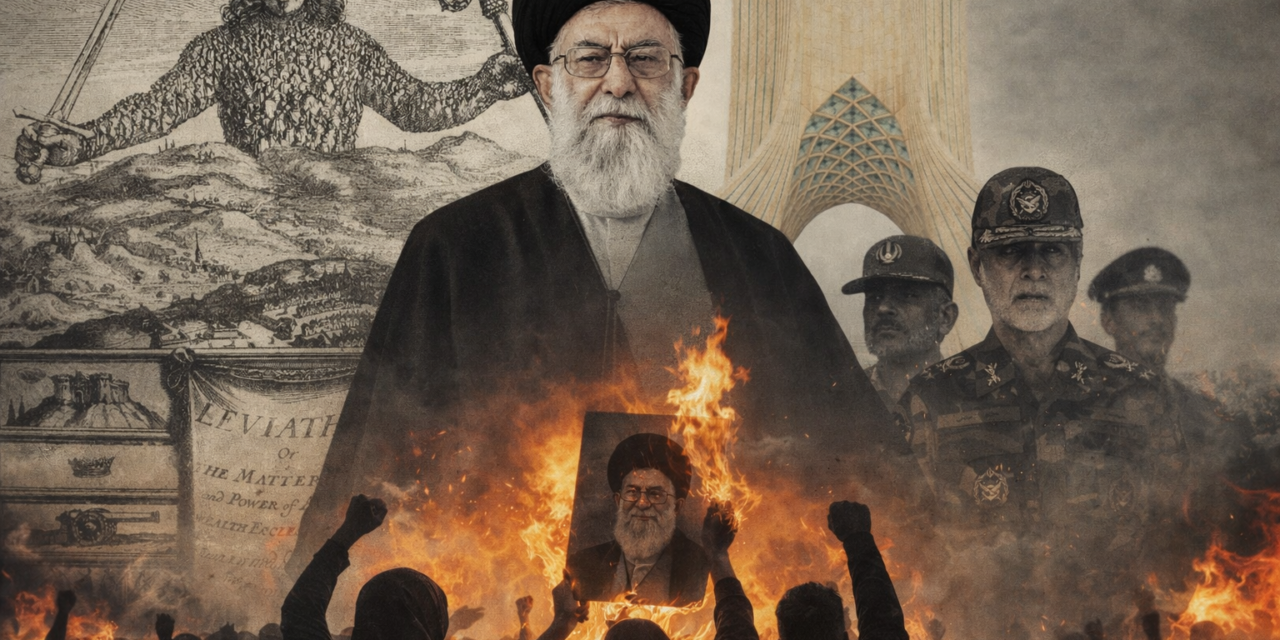
Hobbes, Iran, and Revolution: A Political and Philosophical Examination of Sovereignty and Tyranny
The contemporary crisis of the Islamic Republic of Iran represents one of the most significant empirical tests of absolute sovereignty and social contract theory in the modern era. As the country grapples with a series of overlapping systemic failures, the internal contradictions of its theocratic-authoritarian model have been laid bare by a populace increasingly willing to trade security for the possibility of fundamental change. This report analyzes the current situation in Iran through the lens of Thomas Hobbes’s political philosophy, particularly his conceptions of the sovereign, the state of nature, and the inalienable right to self-preservation. By examining the structural mechanisms of the Iranian state alongside the revolutionary movements of 2022 and 2025-2026, the analysis identifies a terminal fracture in the social contract that once sustained the clerical establishment.
The Architecture of Theocratic Sovereignty: A Hobbesian Parallel
To understand the nature of tyranny in the Islamic Republic, one must first engage with the institutional framework that concentrates power in the hands of a single individual. Thomas Hobbes, in his 1651 masterpiece Leviathan, argued that the only remedy for the chaos and violence of the state of nature—where life is “solitary, poor, nasty, brutish, and short”—is the creation of an absolute sovereign to whom all individuals surrender their natural rights.1 In the Iranian context, this “Leviathan” is embodied in the office of the Supreme Leader (Rahbar), a position established by the 1979 Constitution under Ayatollah Ruhollah Khomeini’s doctrine of Velayat-e Faqih, or the Guardianship of the Islamic Jurist.4
The Supreme Leader serves as the head of state and the highest political and religious authority, standing above the president and the parliament.4 Under Article 110 of the Iranian Constitution, the Supreme Leader is granted nearly unlimited powers, including the delineation of general policies, the command of the armed forces, and the appointment of the head of the judiciary and the members of the Guardian Council.4 This centralized power structure mirrors Hobbes’s insistence that sovereignty must be “indivisible, unlimited, and not subject to any higher authority or legal constraints.”.1
Table 1: Comparative Analysis of Hobbesian Sovereignty and the Islamic Republic
| Feature of Sovereignty | Hobbesian Definition (Leviathan) | Iranian Institutional Manifestation |
| Origin of Authority | The social contract among rational individuals is to escape chaos.1 | Divine governing authority as representative of the Hidden Imam.6 |
| Concentration of Power | Indivisible and absolute; no separation of powers.1 | Supreme Leader controls the judiciary, the military, and policy.4 |
| Coercive Mechanism | “Covenants without the sword are but words.”.10 | Islamic Revolutionary Guard Corps (IRGC) and Basij.6 |
| Accountability | Sovereign is not bound by the laws it creates.1 | The leader is practically immune to oversight by the Assembly of Experts.4 |
| Purpose of State | Preservation of life and provision of security.1 | Preservation of the Islamic Revolution and territorial integrity.5 |
The IRGC serves as the vital “sword” of this Iranian Leviathan, existing as a parallel military and economic state that ensures the survival of the regime against internal subversion and external threats.6 Like Hobbes’s sovereign, who must possess the ultimate power to punish to ensure adherence to the social contract, the Iranian leadership utilizes the IRGC and its volunteer Basij militia to suppress any dissent that threatens the “general policies” of the Islamic Republic.5
The Erosion of the Social Contract and the “State of Nature”
The Iranian state’s current legitimacy crisis can be interpreted as a breakdown of the implicit social contract that has sustained the Islamic Republic since its inception. Hobbes argued that the social contract is a trade-off: individuals surrender their freedom in exchange for security and the conditions for “commodious living”.1 However, as the Iranian state has failed to provide both physical security and economic stability, it has effectively returned its subjects to a condition resembling the “state of nature”—a situation of universal insecurity where the sovereign is no longer a protector but a primary threat to life.16
The Policy of Epistemic Engineering
A critical and often overlooked mechanism of Iranian tyranny is “epistemic engineering”—the systematic realignment of research and education to prioritize regime-legitimizing narratives over critical inquiry.19 Analysis of over 3,000 graduate theses in Iran from 1999 to 2024 reveals a deliberate shift away from studies on domestic governance, civil rights, and institutional reform.20 This process, mediated by centralized curriculum design and ideological surveillance, aims to transform academic disciplines into “anticipatory systems of compliance”.19 In a Hobbesian sense, this is the sovereign’s attempt to control “doctrines” and “opinions,” which Hobbes identified as essential for preventing the internal divisions that lead to civil war.9
Economic Collapse and the Kakistocracy
The failure of the Iranian Leviathan is most visible in its economic mismanagement. By 2025, the economy had deteriorated into what analysts describe as a “closed-loop Ponzi scheme,” sustained by regulatory complicity and the systemic inflation of asset values.12 The Supreme Leader has historically favored loyalists over competent technocrats, leading to a “textbook kakistocracy” managed by the least qualified individuals.21 This has resulted in existential challenges, including water shortages, energy deficits, and a failing electricity grid that compelled President Masoud Pezeshkian to suggest moving the capital from Tehran.21
The World Bank’s 2025 projections, noting the impact of sanctions and declining oil income, suggested that Iran’s economy would shrink significantly while inflation would rise toward 60%.24 In Hobbesian terms, when the sovereign can no longer provide for the “commodious building” and “industry” of the people, the subjects’ obligation to obey begins to dissolve, as the primary purpose of the commonwealth—security and well-being—is no longer being met.10
The “Woman, Life, Freedom” Uprising: Existential Resistance
The revolution of late 2022, sparked by the death of Mahsa Amini in the custody of the morality police, represents a fundamental shift in the nature of Iranian protests.25 Unlike previous movements focused on election results (2009) or fuel prices (2019), the “Woman, Life, Freedom” (WLF) movement was an existentialist and humanist struggle for personal and collective freedom.26
The Paradigm of Autonomy
The WLF movement emphasized bodily autonomy and self-determination, rejecting the identities imposed by the clerical regime.27 From a Hobbesian perspective, this uprising can be seen as the subjects asserting their “Right of Nature”—the inalienable right to preserve one’s own life and dignity when the sovereign’s commands become lethal or dehumanizing.17 The movement was notable for its diversity, uniting the urban middle class, industrial workers, and various ethnic groups (Kurds, Baluchis, Azeris) into a “super-collective” focused on the overthrow of the Islamic Republic.14
Table 2: Comparative Dynamics of Major Iranian Protest Waves
| Movement | Catalyst | Primary Demands | Social Composition | State Response |
| 2009 Green Movement | Alleged election fraud. | Electoral reform: “Where is my vote?” | Urban middle class.14 | Repression; house arrests. |
| 2019 “Bloody Aban.” | 50-200% fuel price hike.26 | Economic relief; regime change.26 | Economically marginalized groups.14 | Mass killings, internet blackout.26 |
| 2022 WLF Movement | Death of Mahsa Amini.25 | Bodily autonomy; overthrow of regime.26 | Cross-class; youth; women; ethnic minorities.27 | Lethal force; “Woman, Life, Freedom” fight vows to continue.32 |
| 2025-2026 Protests | Economic collapse; Israeli strikes.22 | Systemic change; end of foreign proxies.23 | Bazaar merchants, shopkeepers, and students.22 | Unprecedented massacres; 30,000+ deaths.23 |
The 2025-2026 Crisis: The Sovereign Under Siege
The transition from 2025 to 2026 marked a pivotal moment for the Islamic Republic, as external military pressure converged with domestic collapse. In June 2025, Israel and the United States conducted direct strikes against Iran’s nuclear program and military leadership, exposing deep vulnerabilities in the regime’s defense infrastructure.7 These strikes, combined with the loss of key regional allies—such as Bashar al-Assad in Syria—weakened Iran’s “axis of resistance” and stripped the regime of its claim to providing regional security.24
The Snapback Mechanism and Economic Asphyxiation
In September 2025, the reactivation of pre-2015 United Nations sanctions through the “snapback” mechanism further isolated the Iranian state.22 This legal and economic containment translates directly into social consequence: the protests that erupted on December 28, 2025, were not merely political acts but the “social consequence of legal and economic containment”.34 The regime responded by prioritizing strategic reconstruction—particularly of its ballistic missile program—at the expense of economic stabilization or social relief.34 This calculation depends on the continued loyalty of the security apparatus, even as the conditions for the subjects become increasingly unbearable.34
The January 2026 Massacres: “Victory Through Terror”
The uprising that began in late 2025 quickly evolved into the largest challenge to the regime since 1979.23 By early January 2026, millions had taken to the streets in all 31 provinces.23 The response of the Iranian Leviathan was a brutal application of what Hobbesian theory describes as the sovereign’s “unlimited power” to maintain order at any cost.1
*Source: Institute for the Study of War. https://storymaps.arcgis.com/stories/0f3b399d9bbf4063ac6d17958c714383
The Order to Kill
On January 9, 2026, Supreme Leader Ali Khamenei delivered a speech in Qom that served as the “final green light” for a bloody crackdown.31 He labeled protesters as “vandals,” “mercenaries,” and “agents of the enemy,” and ordered security forces—including the Law Enforcement Command (FARAJA), the Basij, and the IRGC—to be in the field with “full authority”.31 Following this speech, senior IRGC commanders reportedly used phrases like “al-nasr bil-ru’b” (victory through terror) in internal briefings.35
The ensuing crackdown was characterized by:
- Direct Live Fire: Security forces utilized assault rifles and heavy machine guns against demonstrators, often deliberately shooting at heads, eyes, and genitals to terrorize survivors.36
- Internet Shutdown: A total nationwide shutdown of the international internet was implemented on January 8, 2026, to engineer a “massacre in silence” and prevent the documentation of state crimes.23
- Mass Casualties: While official state media cited 3,117 deaths, independent human rights organizations like HRANA and Iran International confirmed that between 30,304 and 36,500 people were killed in a matter of days.23
- Systemic Cruelty: Families of the deceased were often forced to pay a “bullet fee” to retrieve bodies for burial, unless they agreed to falsely claim the deceased were Basij members.12
Table 3: Statistical Summary of the January 2026 Crackdown
| Category | Estimated Value (Verified/Credible Reports) | Official State Figure (Martyrs Foundation) |
| Total Deaths | 30,304 – 36,500 23 | 3,117 33 |
| Total Injuries | 330,000 – 360,000 23 | Not disclosed |
| Total Arrests | 42,324 23 | “Several thousand” (per Khamenei) 22 |
| Internet Access | Near-total nationwide shutdown 31 | “Technical disruptions” |
| Judicial Outcome | Directives for “swift and decisive” death trials 31 | No plans for hangings (per Foreign Minister) 22 |
Hobbesian Resistance and the Dissolution of the Social Contract
The central tension in Hobbes’s political philosophy is the degree to which a citizen retains the right to resist sovereign power.9 While Hobbes is generally understood as an advocate for absolutism, his theory contains a fatal limit: the right to self-preservation is inalienable.1 Subjects surrender their rights to the sovereign only to protect their lives; therefore, if the sovereign attempts to kill them or fails to protect them from death, the obligation to obey is terminated.2
The Right to Rebel
Scholar Susanne Sreedhar argues that Hobbesian subjects collectively have a right to rebel when the sovereign is judged to be a threat to their survival.41 This is precisely the condition currently faced by the Iranian people. The regime’s use of “blind mass killing” to prevent a rapid collapse has effectively destroyed its legitimacy and the possibility of a “normal” political life.42 When a sovereign uses slaughter as a tool of survival, it ceases to be a protective Leviathan and becomes a predator, returning the populace to a state of war where each individual must seek their own preservation.2
Hobbes himself acknowledged that subjects who are “in fear of their lives lose their obligations to obey”.2 In the Iranian context, where an estimated 80% of the population views the system as illegitimate, the state is no longer a commonwealth based on consent, but a “pariah state” holding its people hostage through raw violence.12
The “Poisonous Doctrine” of Private Judgment
Hobbes identified the “poisonous doctrine” that “every private man is judge of good and evil actions” as a primary weakness of a commonwealth.41 However, in modern Iran, the systemic failure of the state to provide basic necessities and justice has forced the populace to reclaim this power of judgment. The 2026 uprising, triggered by economic grievances but evolving into a demand for the overthrow of the Islamic Republic, represents a collective rejection of the sovereign’s judgment in favor of the people’s “Right of Nature”.23
The Personalized Leviathan: Succession and Fragility
A significant risk to the Iranian state’s survival is the degree to which Ali Khamenei has personalized his power.42 Hobbes’s Leviathan is meant to be an “artificial person” or an office that exists independently of the natural person holding it.8 However, Khamenei has shaped the Iranian system’s architecture so that every power-holder depends on his personal permission.42 This lack of autonomous power centers makes the system inherently fragile and unable to absorb shocks.42
The Leadership Vacuum
The 2026 crisis has exposed that the heads of government branches—such as the president and the speaker of parliament—function as mere managers rather than independent leaders.42 They lack the capacity to execute survival strategies without Khamenei’s direct guidance.42 As the battle for Khamenei’s successor continues, the system faces a “permanent emergency” where the focus has shifted from governance to the physical survival of the Leader.12 Signs from the United States that it might target the Leader have caused panic within the leadership, with officials signaling that an assault on the Leader is equivalent to “all-out war”.42
Scenarios of Systemic Collapse
Historical patterns suggest that mass killing may buy a government time, but it almost always destroys legitimacy and produces a permanent crisis.14 In Iran, the repression of early 2026 may have quieted the streets, but it has not restored equilibrium.12 Analysts note several possible outcomes:
- A “Gorbachev Moment”: Partial reforms or internal fractures trigger a systemic collapse.14
- Military Takeover: The IRGC, which already controls significant portions of the economy and security apparatus, may sideline the clerical leadership to preserve the state.6
- The Silent Majority: The “silent majority” that remained on the sidelines during the protests—dissatisfied but fearful of chaos—may eventually be pushed into the streets if economic conditions continue to worsen.14
Legitimacy and the Problem of Absolute Power
The Iranian regime’s justification for its crackdowns often rests on the need to prevent “chaos and foreign interference. “.6 This is a fundamentally Hobbesian argument: that the burdens of even the most oppressive government are “scarce sensible, in respect of the miseries… that accompany a Civil Warre”.17 However, this argument fails when the state itself becomes the source of the chaos and the primary instrument of terror.
State-Sponsored Terror
The Iranian Leviathan’s strategy of “victory through terror” involves not only mass killings but also “digital terrorism” and collective psychological torture.31 The nationwide internet shutdown and the seizure of the bodies of those slain are analyzed by legal experts as violations of the right to life and as forms of collective punishment.31 When the state’s law enforcement agencies “re-write the social contract” by presuming all civilians are threats to national security, they eject those citizens from the body politic, effectively returning them to the state of nature.49
The International Legal Framework
The January 2026 massacres have been characterized by organizations like Amnesty International and the UN Special Rapporteur as “crimes against humanity”.31 Under international law, the personal responsibility of the Supreme Leader and senior officials for these killings has become a focal point for the international community.31 There are calls for:
- Universal Jurisdiction: Prosecuting commanders of suppression in foreign courts.31
- Security Council Referral: Referring the case of systematic human rights violations to the UN Security Council for deterrent measures.31
Mathematical and Statistical Modeling of Regime Viability
The stability of an authoritarian regime can be conceptualized as a function of its coercive capacity C, its fiscal resources F, and the level of public dissent D.

In the Iranian case for 2026:
- Coercive Capacity (C): Remains high but is increasingly strained by the need for “martial law” across all provinces.12
- Fiscal Resources (F): Severely depleted by snapback sanctions, banking insolvency, and the costs of military reconstruction.12
- Public Dissent (D): Reached historic levels, with 80% of the population viewing the system as illegitimate.21
As F approaches zero and D approaches infinity, the regime’s viability (V) diminishes, regardless of C. The “victory through terror” in January 2026 was a desperate attempt to artificially suppress D through the application of maximum C, but this is an unsustainable strategy in the face of absolute fiscal exhaustion.
Conclusion: The Irreversible Fracture
The current situation in Iran represents a terminal crisis of the Hobbesian state. The Islamic Republic, established in 1979 as a revolutionary alternative to monarchy, has evolved into a tyrannical Leviathan that consumes its own subjects to maintain its existence. The massacres of January 2026, intended to save the system from collapse, have instead finalized the dissolution of the social contract.
The Iranian leadership’s belief that it can manage society through “blind slaughter” and “digital blackout” ignores the fundamental lesson of political science: a state that fails to provide the basic security of its citizens loses its right to their obedience. The “Woman, Life, Freedom” movement and the 2026 uprisings demonstrate that the Iranian people have reached a point where the risks of the state of nature—a “war of all against all”—are perceived as preferable to the certainty of death and degradation under a tyrannical sovereign.
While the regime retains significant coercive power and a demonstrated willingness to kill, it faces a population that has fundamentally transformed its mentality. Individuals are reclaiming their “shattered lives, lost youth, repressed joy, and dignity”.27 The clerical establishment, built around the personalized rule of a single octogenarian, is unprepared for a world without his guidance, and the internal fractures exposed by the 2026 revolution suggest that the Islamic Republic is entering its “hardest ever year,” with systemic collapse becoming increasingly likely.12 The Iranian Leviathan, having abandoned its duty to protect, now stands as the very biblical monster Hobbes once warned against—not as a source of peace, but as a source of perpetual and lethal war against its own people.
Works cited
- Hobbes and the Leviathan: absolute sovereignty | Political Philosophy Class Notes, accessed January 28, 2026, https://fiveable.me/political-philosophy/unit-5/hobbes-leviathan-absolute-sovereignty/study-guide/az4EEQls6UpiILLa
- Leviathan | Thomas Hobbes, Summary, Social Contract, Sovereign Authority, & Facts, accessed January 28, 2026, https://www.britannica.com/topic/Leviathan-by-Hobbes
- THE EXPLANATION OF CONFLICT IN HOBBES’S LEVIATHAN, accessed January 28, 2026, https://www.kirj.ee/public/trames/trames-2006-1-1.pdf
- Supreme Leader of Iran – Wikipedia, accessed January 28, 2026, https://en.wikipedia.org/wiki/Supreme_Leader_of_Iran
- Inside Iran – The Structure Of Power In Iran | Terror And Tehran | FRONTLINE – PBS, accessed January 28, 2026, https://www.pbs.org/wgbh/pages/frontline/shows/tehran/inside/govt.html
- Iran’s Power Structure – ICT, accessed January 28, 2026, https://ict.org.il/irans-power-structure/
- The Islamic Republic’s Power Centers | Council on Foreign Relations, accessed January 28, 2026, https://www.cfr.org/articles/islamic-republics-power-centers
- Thomas Hobbes concept of sovereignty and it’s implications for constitutional democracy in Nigeria – ScienceOpen, accessed January 28, 2026, https://www.scienceopen.com/hosted-document?doi=10.14293/PR2199.001143.v1
- Hobbesian Sovereignty and the Rights of Subjects: Absolutism Undermined? – Kent Academic Repository, accessed January 28, 2026, https://kar.kent.ac.uk/id/document/3196023
- A Critique of Hobbes’ Notion of the Absolute Sovereign Azibalua Onyagholo & Emmanuel Ekadi Abstract This study is a critiq, accessed January 28, 2026, https://www.ajol.info/index.php/abraka/article/view/242967/229801
- The Illusion of Liberty: An Analysis of Sovereignty and Collective Freedom in Hobbes’s Leviathan – Arts One – The University of British Columbia, accessed January 28, 2026, https://artsone.arts.ubc.ca/student-journal/the-illusion-of-liberty/
- Iran’s coming reckoning: Regime collapse is likely — democracy is not – Middle East Institute, accessed January 28, 2026, https://mei.edu/commentary/irans-coming-reckoning-regime-collapse-is-likely-democracy-is-not/
- Hobbes’ Conception of Liberty Under an Absolutist Sovereign – PolSci Institute, accessed January 28, 2026, https://polsci.institute/classical-political-philosophy/hobbes-conception-liberty-absolutist-sovereign/
- Iran at a crossroads: Repression, resistance and scenarios – European Policy Centre, accessed January 28, 2026, https://www.epc.eu/publication/iran-at-a-crossroads-repression-resistance-and-scenarios/
- Leviathan No More: The Right of Nature and the Limits of Sovereignty in Hobbes | The Review of Politics | Cambridge Core, accessed January 28, 2026, https://www.cambridge.org/core/journals/review-of-politics/article/leviathan-no-more-the-right-of-nature-and-the-limits-of-sovereignty-in-hobbes/67267A558B3CB4E6B6ED19B0A8AC1F86
- Thomas Hobbes: Moral and Political Philosophy, accessed January 28, 2026, https://iep.utm.edu/hobmoral/
- Hobbes’ moral and political philosophy, accessed January 28, 2026, https://plato.stanford.edu/archives/spr2024/entries/hobbes-moral/
- “In the Shadow of Sovereignty: A Dark Examination of Hobbes, Sovereign ” by Sidney Dombrovskis – Digital Showcase @ University of Lynchburg, accessed January 28, 2026, https://digitalshowcase.lynchburg.edu/utcp/347/
- Policy-Mediated Epistemic Control: How Authoritarian Regimes Repurpose Graduate Political Science Research Agenda–The Case of Islamic Republic of Iran – ResearchGate, accessed January 28, 2026, https://www.researchgate.net/publication/394350422_Policy-Mediated_Epistemic_Control_How_Authoritarian_Regimes_Repurpose_Graduate_Political_Science_Research_Agenda-The_Case_of_Islamic_Republic_of_Iran
- Policy-Mediated Epistemic Control: How Authoritarian Regimes Repurpose Graduate Political Science Research Agenda–The Case of, accessed January 28, 2026, https://d-nb.info/1380152232/34
- Iran’s coming reckoning: Regime collapse is likely — democracy is …, accessed January 28, 2026, https://mei.edu/commentary/irans-coming-reckoning-regime-collapse-is-likely-democracy-is-not
- Iran protests 2026: UK and international response – The House of Commons Library, accessed January 28, 2026, https://commonslibrary.parliament.uk/research-briefings/cbp-10462/
- 2025–2026 Iranian protests – Wikipedia, accessed January 28, 2026, https://en.wikipedia.org/wiki/2025%E2%80%932026_Iranian_protests
- Iran: What challenges face the country in 2026? – The House of Commons Library, accessed January 28, 2026, https://commonslibrary.parliament.uk/research-briefings/cbp-10456/
- Case study: Woman, Life, Freedom | The Office of the Gender and Women’s Studies Librarian | UW-Madison Libraries, accessed January 28, 2026, https://www.library.wisc.edu/gwslibrarian/bibliographies/embodied-transnational-feminisms/case-study-woman-life-freedom/
- Mahsa Amini protests – Wikipedia, accessed January 28, 2026, https://en.wikipedia.org/wiki/Mahsa_Amini_protests
- “Woman, Life, Freedom”: A Movement in Progress in Iran – DigitalCommons@URI, accessed January 28, 2026, https://digitalcommons.uri.edu/cgi/viewcontent.cgi?article=1372&context=dignity
- Will the Women’s Movement in Iran Grow into a National Liberation Movement? – MDPI, accessed January 28, 2026, https://www.mdpi.com/2076-0760/14/5/272
- Resisting the Scaffold: Self-Preservation and Limits of Obligation in Hobbes’s Leviathan – University of Guelph, accessed January 28, 2026, https://www.uoguelph.ca/arts/sites/uoguelph.ca.arts/files/public/Resisting_the_Scaffold_Self-Preservation.pdf
- Interpreting Hobbes on Civil Liberties and Rights of Resistance (Chapter 8), accessed January 28, 2026, https://www.cambridge.org/core/books/interpreting-hobbess-political-philosophy/interpreting-hobbes-on-civil-liberties-and-rights-of-resistance/7EE2DB86AEE36666542D7990A82AB4F2
- Digital Blackout and the Order to Kill in Iran: A Legal Analysis of …, accessed January 28, 2026, https://iran-hrm.com/2026/01/10/order-to-kill-in-iran-khamenei-january-9-speech/
- Iranian labor, social groups vow Woman, Life, Freedom fight will continue | Iran International, accessed January 28, 2026, https://www.iranintl.com/en/202509099001
- 36500 deaths in context: How Iran’s toll compares with wars and crackdowns, accessed January 28, 2026, https://www.iranintl.com/en/202601277218
- 2026 will test the limits of Tehran’s endurance | Iran International, accessed January 28, 2026, https://www.iranintl.com/en/202601053422
- Over 36500 killed in Iran’s deadliest massacre, documents reveal, accessed January 28, 2026, https://www.iranintl.com/en/202601255198
- 2026 Iran massacres – Wikipedia, accessed January 28, 2026, https://en.wikipedia.org/wiki/2026_Iran_massacres
- Human Rights Council Adopts Resolution Extending Mandates of Fact-Finding Mission and Special Rapporteur on Iran and Calling for an Urgent Investigation into Human Rights Violations in Iran in the Context of the Protests Beginning 28 December 2025 | OHCHR, accessed January 28, 2026, https://www.ohchr.org/en/media-advisories/2026/01/human-rights-council-adopts-resolution-extending-mandates-fact-finding
- Iran: Authorities unleash heavily militarized clampdown to hide protest massacres, accessed January 28, 2026, https://www.amnesty.org/en/latest/news/2026/01/iran-authorities-unleash-heavily-militarized-clampdown-to-hide-protest-massacres/
- Hobbesian Sovereignty and the Rights of Subjects – Brill, accessed January 28, 2026, https://brill.com/downloadpdf/journals/hobs/32/2/article-p209_209.pdf
- Hobbesian Resistance Peter J. Steinberger American Journal of Political Science, Vol. 46, No. 4. (Oct., 2002), pp. 856-865. – Brian C. Ventura, accessed January 28, 2026, https://brianventura.files.wordpress.com/2010/03/hobbesian-resistance.pdf
- Hobbes on Resistance: Defying the Leviathan | Reviews | Notre …, accessed January 28, 2026, https://ndpr.nd.edu/reviews/hobbes-on-resistance-defying-the-leviathan/
- Mass Killing, Then Panic: The Islamic Republic’s Post-Crackdown …, accessed January 28, 2026, https://en.radiozamaneh.com/37682/
- Full article: Hobbesian resistance and the law of nature – Taylor & Francis, accessed January 28, 2026, https://www.tandfonline.com/doi/full/10.1080/17496977.2023.2170685
- LEGITIMACY CRISES, CIVIL DISSENT, AND THE STRUGGLE FOR IDENTITY IN POST-ISLAMIC REPUBLIC IRAN – AgEcon Search, accessed January 28, 2026, https://ageconsearch.umn.edu/record/373303/files/BEYOND%2BTHE%2BVEIL_%2BLEGITIMACY%2BCRISES%2C%2BCIVIL%2BDISSENT%2C%2BAND%2BTHE%2BSTRUGGLE%2BFOR%2BIDENTITY%2BIN%2BPOST-ISLAMIC%2BREPUBLIC%2BIRAN.pdf
- The expert conversation: Should Trump strike Iran? What happens next if he does?, accessed January 28, 2026, https://www.atlanticcouncil.org/dispatches/the-expert-conversation-should-trump-strike-iran-what-happens-next-if-he-does/
- Thomas Hobbes And His Political Philosophy – Analysis – Eurasia Review, accessed January 28, 2026, https://www.eurasiareview.com/26112025-thomas-hobbes-and-his-political-philosophy-analysis/
- Sovereignty as a Vocation in Hobbes’s Leviathan – Universiteit Leiden, accessed January 28, 2026, https://www.universiteitleiden.nl/en/research/research-output/governance-and-global-affairs/sovereignty-as-a-vocation-in-hobbess-leviathan
- Why ‘locked and loaded’ US is still holding back on Iran, accessed January 28, 2026, https://www.iranintl.com/en/202601260393
- Full article: Critical terrorism studies (CTS): (State) (sponsored) terrorism identified in the (militarized) pedagogy of (U.S.) law enforcement agencies – Taylor & Francis, accessed January 28, 2026, https://www.tandfonline.com/doi/full/10.1080/23311886.2019.1586813
Latest Posts
- Geopolitical Energy Containment: Operation Epic Fury and the Strategic Reconfiguration of the Persian Gulf – China Axis
- Hobbes, Iran, and Revolution: A Political and Philosophical Examination of Sovereignty and Tyranny
- Iran-Israel War: Advanced Electronic & Laser Warfare
- The Great Realignment: Geopolitics, Power Shifts, and the Fracturing Global Trade Order
- Best Practices to Event Security

